
Stakeholder Meeting in Warsaw, 19 November 2014:
The Stakeholder Meeting took place in Warsaw on 19th of November 2014, between 2.00 pm and 5 pm. A hall in one of the buildings of the Warsaw School of Economics, the location of which has good transport connection within the city, had been chosen as the venue for the meeting. The Polish team involved in the project cooperatively compiled a list of 48 persons who were given an invitation. The list of the invited included policy makers framing policy on air protection, representatives of local councils, as well as officers of the public administration in charge of policy implementation, monitoring and quality control, scientists from research institutes and institutions of higher education, independent experts and representatives of non-government organizations acting in the area of issues discussed during the meeting. The invitation was also extended to people dealing with preventive care, medical doctors and scientists involved in the issue of air pollution and its effects on human health.
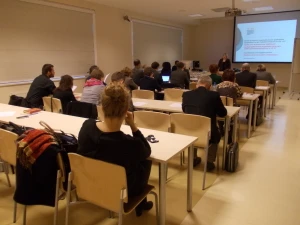
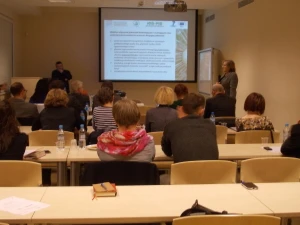
The meeting was attended by 22 people. Beside a presentation depicting the most important assumptions of the SEFIRA project, the conveners had also prepared two subject-related presentations: the first concerning the level of air pollution in Poland and the second on the effects of inappropriate air quality. The presentations facilitated the introduction into a discusson and depicted currently applied or feasible for application in the future actions aiming to improve air quality and curb the intensity of pollution. The presentation on the aims, guidelines and research methods of the SEFIRA project was made by Ms Izabela Buchowicz on behalf of the whole Polish team involved in the project and as a substitute of its director – prof. Piotr Błędowski. The first subject – related presentation entitled ‘Nationwide and local problems of air pollution – in the search for effective solutions’ was made by the head of the Air Pollution Monitoring Department of The Institute of Environmental Protection – National Research Institute: Mr Dominik Kobus. In general, his presentation concerned measurement results and assessment of air quality and causes of air pollution and possible methods of its limitation. At the beginning, the audience was acquainted with samples of articles from newspapers and Internet which are frequently written in alarmist tone and draw people’s attention to the problem of air pollution and occurrence of exceeded pollution limits taking place primarily in the regions of Silesia and Krakow and Warsaw as well.
Next, the most recent results of air quality measurement and assessment were discussed – including the results of research and mathematical modelling of: the area of Warsaw, the whole country, and this situation of Poland as against Europe. The presentation mainly pertained to Coarse Particles (PM10), benzo[a]pyrene, ozone and nitrogen dioxide. The next presented point listed the main sources of PM10 emission with Warsaw in particular. Coarse Particles pollution, along benzo[a]pyrene, are the main problems of poor air quality in Poland. Combustion processes in the systems of household central heating constitute the primary source of the emission.
Having discussed the criteria of effectiveness of possible actions aiming at limiting of concentration of air pollution, samples of actions noted in the adopted air protection programme in Warsaw were presented. Those actions were grouped according to the spheres: vehicle and railway transport, industry, heating (sphere of living and municipal services) education, area management. The presentation also featured short term actions which can be undertaken in case of occurrence or risk of occurrence of exceeding of alarm levels. Samples of actions and solutions adopted in many European cities but not applied in Warsaw, were shown at the end of the presentation.
The second presentation entitled ‘Health, social and economy wise effects of air pollution’ was made by Mr Eng. Krzysztof Skotak – the head of the Integrated Monitoring Station ‘Puszcza Borecka’ of the Institute of Environmental Protection – National Research Institute. The presentation encompassed summaries and publications of the most recent research results in the sphere of air pollution impact on health with close attention to the most important risk factors and mechanisms and sources of air pollution emergence. Particular attention was paid to the conditions of metropolitan areas – based on the example of Warsaw. The presentation made reference to the assessment of danger levels in relation to the currently effective in the EU permissible values and recommendations of the World Health Organization. Heath, economy and social related effects of inappropriate air quality in Poland were juxtaposed with data from other European countries.
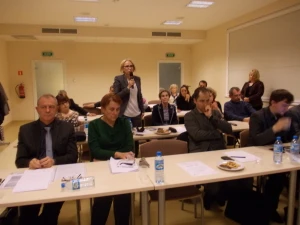
Having finished both factual presentations, the most important issues were listed which became an additional contribution for the discussion (the issues were displayed during the whole discussion). The discussion was a fundamental part of the meeting. The gathered participants asked questions and commented on the presented issues; discussed with each other exchanging their experience, views; and made references to reliable sources of information supporting their views. The discussion was ardent and brisk. Many speeches were quite emotional.
The exchange focused on:
- assessment of level of air pollution in Poland with particular reference to conditions in towns and out of cities with emphasis on area diversification and the most polluted places.
- comparisons of causes and sources of air pollution in various regions of Poland with reference to situation in other European countries.
- principles of assessment of economic and health implication and interpretation of the presented methods of risk assessment,
- undertaken action in the sphere of air quality monitoring, its protection and improvement and informing on hazards
- issues of financing of actions pertaining to curbing on air pollution as well as its assessment and monitoring and scopes of activities of the responsible services.
One of the conclusions that emerged at the end of the meeting was awareness of need of more frequent meetings of all stakeholders involved in the issue of air protection; and necessity of exchange of information, views and experience – also in the span of the actions planned by policy makers. The conveners of the meeting – the Polish team of the SEFIRA project – received an invitation for a meeting alike which is due to take place soon in the Warsaw University of Technology. The meeting is organised within the frame of the execution of one of the European projects conducted by the University on a comparable subject matter.
Photo gallery of the meeting:
Presentations in PDF
SEFIRA_SM_WARSAW_2014_D_KOBUS_vfin SEFIRA_SM_WARSAW_2014_K_SKOTAK_vfin
SEFIRA_SM_WARSAW_2014_K_SKOTAK_vfin SEFIRA_SM_WARSAW_2014_ZAGADNIENIA
SEFIRA_SM_WARSAW_2014_D_KOBUS_vfin