
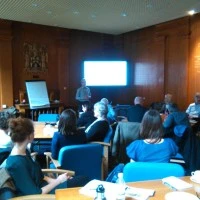
On 11 March 2015, Guy’s Hospital, London, hosted an Air Pollution Exposure – Policy and Practice Stakeholder Workshop. The workshop was arranged by the NIHR Biomedical Research Centre at Guy’s and St Thomas’ NHS Foundation Trust and King’s College London in support of the SEFIRA project.
The attendance was outstanding and included a diverse range of stakeholders such as Local Authorities, members of environmental and health groups, leading academics, politicians and health professionals.
Through a combination of presentations, Q&A and moderated discussions, the programme provided an opportunity to capture the stakeholders’ views on the development of effective policy and best practice relating to public health improvement through air pollution exposure reduction. These views were discussed in relation to both local and EU-wide health benefits, social acceptance and economic impact.
The afternoon kicked off with an introductory presentation by Dr Ben Barratt from the Environmental Research Group. Dr Barratt outlined some of the most challenging issues regarding air pollution exposure policy and practice, such as the technical vs. the behavioural change in EU and national air quality policy development, the current need for increased emphasis on public health protection and risk reduction (disease development and alleviation) and the growing need for communicating the relevant public health messages.
Dr Barratt presentation was followed by Professor Martin Williams from the Environmental Research Group. He provided the attendees with a compelling overview of the development of European Union Policies on Exposure Reduction.
The final presentation was delivered by Dr Sotiris Vardoulakis from Pubic Health England; Dr Vardoulakis talked about the health aspects of air pollution and gave a review of EU policies.
Following the presentations, the attendees were divided into discussion groups in order to attempt to tackle three different questions. After an exhilarating discussion, each of the groups drew the following conclusions:
Group 1 question: “Should air quality policies prioritise compliance with limit values or the improvement of public health?”
The group highlighted that reducing air pollution in London can be particularly challenging as the Mayor and each administering local authority have different agendas and particular interests. The group concluded by highlighting that since air pollutants are transboundary, it is important to not only address air pollution issues at a local level but it is also at an European level so all Members States are committed to address air pollution issues and are willing to implement the required policies.
Group 2 question: “Does air pollution exposure reduction have a distinct role as a public health message?”
The group stressed that it is likely that individuals will be more willing to accept and receive the message if this comes from a trustworthy messenger such as their General Practitioner. However, it is unknown the extent to which General Practitioners will be willing to convey the message.
The group also highlighted that in order for people to understand an air pollution risk message, air pollution must be high up in people’s perceptions and they must be able to “see” air pollution so they can avoid it. This is now possible by the recent development of apps which enable individuals to virtually “breathe” local air. This evidence should always be accompanied by the appropriate advice and information as to how individuals can minimise their air pollution exposure.
Group 3 question: “Is personalised health risk information necessary to encourage behavioural change in communities?”
The participants’ views from this group varied considerably and perhaps more questions than answers were raised. These differences could be attributed to the lack of sound evidence in this area. However, they all agreed that the message to communicate should not only provide advice as to how to avoid air pollution but it should also provide advice as to how to produce less air pollution at an individual level.
Overall, the workshop was an inspiring and an informative event that provided and exceptional opportunity for convening different views in regard to the development of effective policy and best practice to public health improvement through air pollution exposure reduction.
By Diana Silva, King’s College London
PDF VERSION