
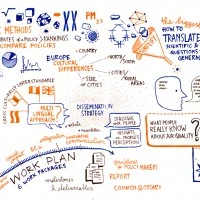
Sefira Project starts meeting with stakeholders from civil society to policy makers and experts.
According to the project plan, the scientific staff of Sefira Coordination Project, is starting to meet face to face with thosewho live and suffer every day the effects of air pollution and struggle to find effective solutions in real life.
Meetings are planned in
Belgium – Antwerp
Italy – Milan
Poland -Warsaw
United Kingdom – London
Sweden – Malmö
The first meeting took place on October 2nd in Antwerp – Belgium
Belgium Stakeholder meeting, October 2nd in Antwerp (click on the link for the program in Flemish)
Stakeholder meeting and public event in Antwerp: a report.
The Belgian stakeholder meeting took place on Thursday the 2nd of October 2014, and consisted of an afternoon program for which 45 stakeholders were invited in a targeted way, and a public lecture in the evening, open for a larger audience. The aim of the meetings was to both gather and disseminate knowledge on air quality and its policies. The overarching theme of the day was traffic-related air pollution (including noise pollution), which is a topic of huge relevance in Antwerp.
The afternoon program started with an introductory lecture by Marcus Amann (IIASA) focussing on ‘the challenges of air pollution policy at the European Level’, followed by a short discussion. Subsequently, three parallel workshops took place. They had the form of ‘round tables’ enabling stakeholders to learn from each other and allowing SEFIRA to gather supplementary information on and insights into the current situation of air quality policies in Antwerp, and their interactions with other policy levels.
The first workshop was entitled “How far do we get with the clean car?”. The following questions were addressed: Are stricter EURO norms the solution? Or are technological solutions insufficient without a reduction and/or displacement of traffic flows? If (part of) the solution, how can stricter EURO norms be realised more easily? Which are the obstacles for their implementation, and how can these be removed? If EURO norms are not the solution, what else should happen?
The second workshop dealt with “Health impact measurements in the context of infrastructure works”. The workshop started from the observation that environmental impact assessments, which, amongst others, measure health effects, are obligatory in the case of large infrastructure projects. This observation triggers a number of questions: do these assessments take the health impact on citizens sufficiently into account? Would it be useful or possible to express this impact also in economic terms? Would large infrastructure projects (such as the Oosterweel connection in the case of Antwerp) still be profitable if health impacts were to be included in the economic calculation? Or would alternative projects (such as capping the ring of Antwerp) be realised more quickly if health economic advantages would be accounted for?
The third workshop was entitled “Just air”? It provided the setting for a discussion on a number of declarations that state that no measure ought to be taken which increases health inequality. Central questions that were brought to the fore are: can these declarations function as instruments to stop certain infrastructure projects? How should health inequality exactly be understood? Which parameters are relevant? How is the situation with regard to health (in)equality in Antwerp/Belgium? To what extent is air pollution shifted to third parties, such as neighbourhoods, specific social groups? Who wins and who loses if new infrastructure projects are built?
The evening program was aimed at disseminating knowledge to a broad audience of interested stakeholders and citizens. This event was organised in collaboration with the action groups StRaten-generaal and Ademloos, as it coincided with their 15th Horta evening (the 15th public lecture in the by now famous Horta building).
The evening consisted of three keynote lectures by SEFIRA scholars, and one by Jan Cortvriend of EC-DG Environment.
Martin Williams (KING’S College) opened the evening with a keynote on European air quality standards. He focussed especially on health issues, which particularly interested the audience.
Second, Michela Maione (UNIURB) delved into the links between air pollution and climate change, showing that these problems in fact constitute two sides of the same coin. She also discussed possible win-win strategies to address both problems.
Third, Jan Cortvriend (EC-DG Environment) zoomed in on the impact of transport on air quality and on new legislative initiatives in this field. As a final touch, Ben Barratt (KING’S College) gave a keynote on his innovative research on participatory processes in monitoring air pollution, which can also help raise awareness and change behaviour.
With several hundreds of participants, the event successfully launched SEFIRA to a wider Belgian audience. An interview with Martin Williams and Ben Barratt which had appeared a few days earlier in the influential local newspaper Gazet van Antwerpen gave an extra boost to promoting the event and disseminating our research.
by Anneleen Kenis (K.U. Leuven)
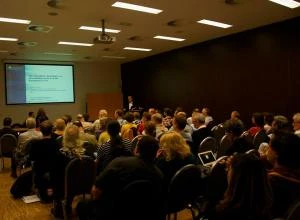
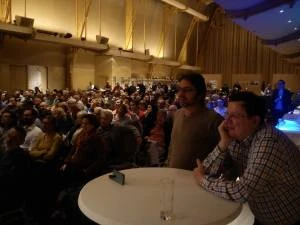
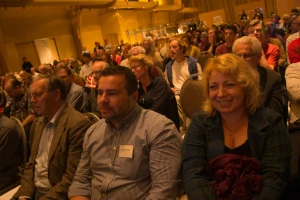
Photos from the stakeholder meeting in Antwerp
Here you can find the PDF of the speeches from Sefira Partners in Antwerp:
-THE CHALLENGES OF AIR POLLUTION POLICY AT EUROPEAN LEVEL: THE WHAT, HOW AND WHY OF THE CURRENT DIRECTIVES AND A LOOK INTO THE FUTURE.
Marcus Amann (IIASA)
SM_Antwerp_Amann_talk
–EUROPEAN AIR QUALITY STANDARDS
Martin Williams (KING’S COLLEGE LONDON)
SM_Antwerp_Williams_talk
-AIR QUALITY, ACTION AND PARTICIPATION
Ben Barratt (KING’S COLLEGE LONDON)
SM_Antwerp_Barratt_talk