Report of the meeting
The Stakeholder meeting in Malmö took place on 10 December 2014 at the offices of Länsstyrelsen Skåne, the county administration that is responsible for drafting the air quality plan for the city of Malmö. The meeting was organized in cooperation between SEFIRA and the city of Malmö, which made it possible to bring together the key stakeholders involved in the drafting, implementation and follow-up of the air quality plan in Malmö. There was considerable interest also from a number of other Swedish cities and county administrations, including Helsingborg, Göteborg and Stockholm. Other participants included representatives from the European Environment Agency, the Swedish Environmental Protection Agency, the Swedish transport authority and Lund University researchers working on the topic of air quality.
The meeting took place at a time when Malmö and other Swedish cities are required to evaluate their current air quality plans and decide on how to move forward in order to achieve Swedish air quality standards. The timing of the stakeholder meeting thus provided opportunities to make the discussions directly relevant to the different actors involved. It was therefore decided that the topic of the event would be ‘Ways forward with Malmö’s air quality policy’. The main objective of the meeting was to provide a forum for the different stakeholders to exchange experiences with respect to the challenges in making the city’s air quality plan effective as well as future possibilities for improving it. Given the broad range of participants, the meeting also served as a forum at which strategies and opinions on air quality policy from different cities could be compared.
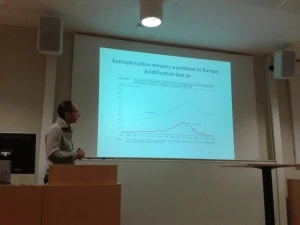
The day’s event was organized around a number of presentations, workshops and a roundtable discussion towards the end. There was ample time for questions and comments and participants eagerly made use of this to initiate lively discussions on the desired direction, objectives as well as limitations of current air quality policies. The participation of Lund researchers and the EEA added valuable perspectives on current state of research, on the health implications of low-level exposure to pollutants, on the European policy framework and experiences from elsewhere in the EU. While the focus was mainly on NO2 – since this is the focus in Malmö’s air quality plan – a number of presentations also elaborated on the broader context and highlighted for example the state of play with respect to emissions of particulate matter.
All in all, the Malmö stakeholder meeting clearly fulfilled a need for a fuller exchange of perspectives and experiences between and across policy scales, and between policy makers and researchers. Some participants afterwards remarked that it would be useful to expand on the idea of the meeting and include an even broader target group.
Download speakers presentations and program in PDF (Swedish language)
PROGRAM – Stakeholder_mtg_Åtgärdsprogrammet_2014
åp_göteborg_141210
AQ_VFO_101214_FINAL
Ebba-malmöstakeholdersdec2014
Malmö_åtgärdsprogram_141210
Malmö Swietlicki – 20141210
MRJ_svensk luftkvalitetslagstiftning